Private markets software for family office funds, property and loans.
INVARIO records private equity funds, property and loans on the same double-entry ledger as the bank portfolios, so they count in one total in your reporting currency.

Private assets on the same ledger as securities
Banks report the securities and cash they hold, not a property, a fund commitment or a direct holding. Those go on the same ledger, valued in your reporting currency and counted once.
A fund commitment is what the family has agreed to invest, drawn down through capital calls over years. Each call and distribution posts against it, and each property stays linked to its mortgage.
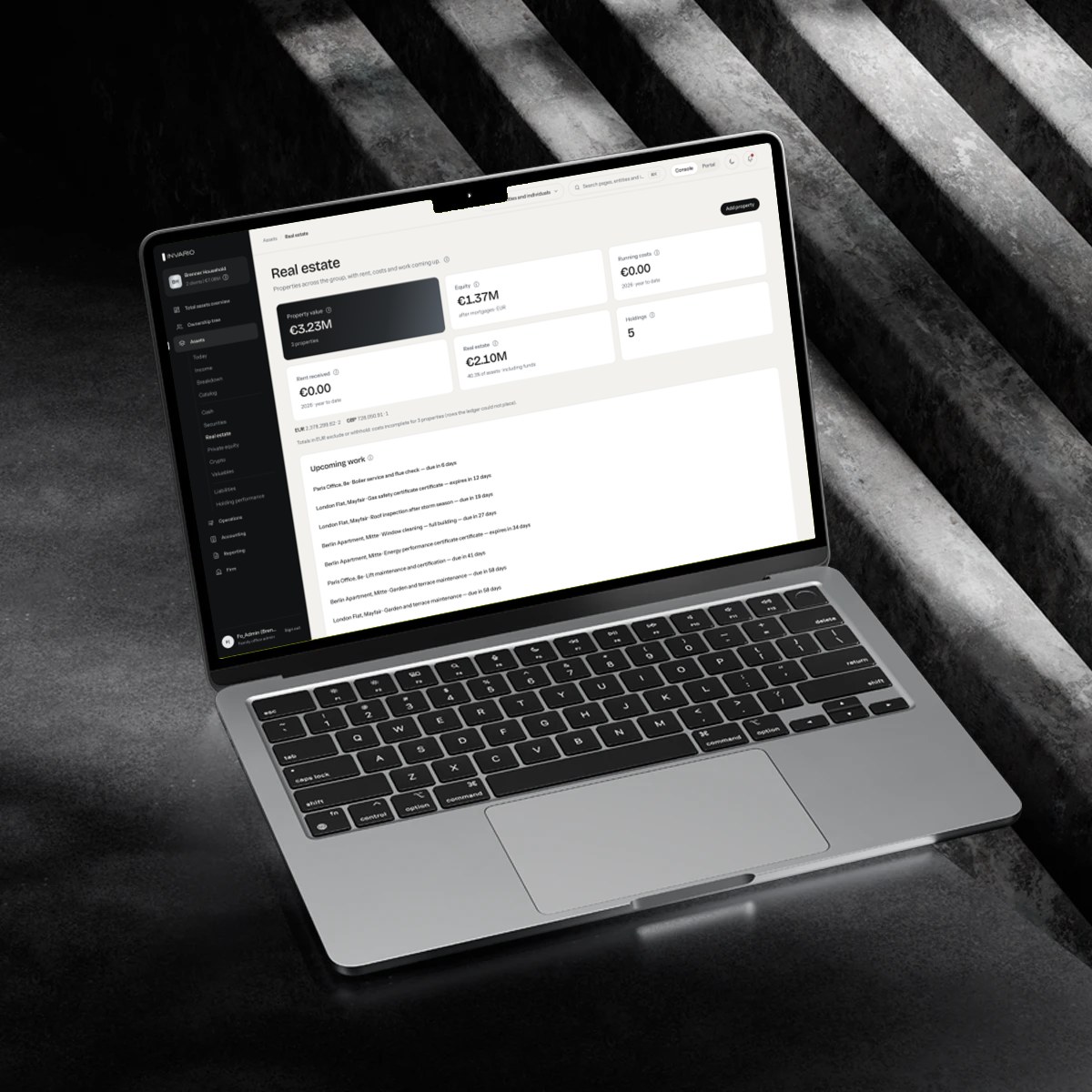
Each property, with its value, equity, rent and works.
Value, equity after mortgages, rent and upcoming works for each building.

Property details
- Property value
- €3.23M 3 properties
- Equity
- €1.37M after mortgages
- Share of assets
- 40.3% including funds
- Next work
- Boiler service due 16 November 2026
Each fund, from its first call to its latest valuation.
Commitment, capital called and net asset value for each fund.

Fund details
- Commitment
- €40.0M
- Called
- €31.0M 78%
- Uncalled
- €9.0M
- Net asset value
- €38.2M
What INVARIO records for private assets
Six capabilities keep funds, property and loans current in the same books as the securities, each event posted by double entry.
Fund multiples compare value with capital paid in: TVPI total value, DPI distributions and RVPI remaining value.

From a fund noticeto the updated figures.
Three steps for every private asset event.
-
The event is recorded
A capital call, distribution, NAV update, rent payment or valuation is recorded with its notice attached.
-
It posts to the ledger
It follows the same double-entry rules as a listed trade. Loan-funded CAPEX posts as two linked transactions.
-
The figures update
Commitments, multiples, J-curves and the consolidated total all reflect the event.
Questions about private markets.
What offices ask about funds, property and loans.
Which private assets can INVARIO hold?

Private equity and closed-end funds, property, loans and direct holdings, on the same ledger as bank portfolios.
What is a mature fund template?
A J-curve forecast for funds already invested. The vintage template is for funds still drawing capital; both can be adjusted.
How is loan-funded CAPEX handled?
The drawdown and the capital spend post as two transactions together, so the books never show half the event.
Do private assets appear in reports?
Yes. They sit on the same ledger as the bank portfolios, so they appear in every allocation, report and portal view.
See a fund, a propertyand its loan in the books.
We walk you through a fund, a property and its mortgage on anonymised data.